Have You Only One Blessing?
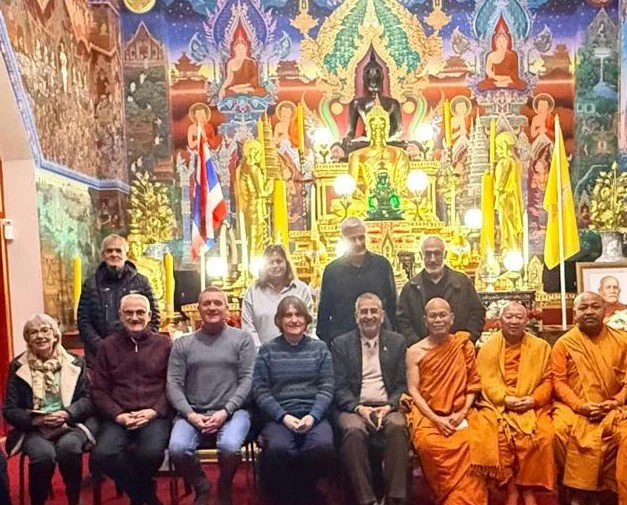
Standing yesterday amidst the vivid golds and reds of the Buddhist temple just around the corner, the immediate sensation was one of overwhelming abundance. It was a sensory immersion into a way of seeking the Divine entirely distinct from the Jewish path of text, law and history. It was visual, silent and undeniably rich. It served as a fitting conclusion to a month of interfaith encounter, a journey that began with our Civic Shabbat and moved through various moments of shared dialogue.
Carrying that feeling of openness back to the Torah reading for this Shabbat, however, creates a jarring dissonance.
The narrative of Parashat Toldot is well known. The soup, the disguise, the deception—these are the mechanics of the plot. But beneath the family drama lies a deeply tragic understanding of our covenant with God. It is a worldview governed by a terrifying sense of scarcity.
The entire narrative rests on the premise that there is simply not enough to go around. There is not enough birthright. There is not enough love. And most devastatingly, the characters seem to operate on the belief that there is not enough holiness.
When Esau discovers that Jacob has received the blessing, he assumes that there is not another blessing for him, that the spiritual bank is empty. He lets out a cry that mirrors the pain of anyone who has ever felt there is no room for them in the sanctuary:
‘Have you but one blessing, my father? Bless me, me also, O my father’ (Genesis 27:38).
Isaac’s trembling reaction seems to confirm Esau’s fear. In that ancient moment, the blessing is viewed as a finite resource, a pie that can be sliced only so many times before it is gone. If Jacob wins, Esau must lose. If one is chosen, the other is cast aside. It appears to be a zero-sum game of spiritual survival.
This is a heavy inheritance. For centuries, much of the religious world has operated on this default setting. The assumption has been that truth is exclusive. Communities are often trained to guard their covenant jealously, harbouring a quiet fear that ‘validating the truth of another’ somehow diminishes their own. If one admits the beauty of the temple around the corner, does it somehow tarnish the aura of one’s own sanctuary?
This scarcity mindset creates a fortress mentality. It suggests that God is small, limited and easily exhausted.
But here is a different theological response. One that moves from scarcity to abundance, to a God who is truly infinite. And this God, the Infinite one, cannot run out. The Source of Life cannot be depleted by the election of one people or the revelation of one Torah. To believe that the prayers of neighbours compete with one’s own for God’s attention is to misunderstand the nature of the Divine.
I want to draw your attention for a moment towards the Aleinu, our concluding prayer in nearly each service. In the first paragraph, the prayer praises God who ‘has not made us like the families of the earth’. Historically, this has often been interpreted through that lens of scarcity, drawing a sharp, potentially painful line between ‘us’ and ‘them’.
A comment on it in our prayerbook offers a gentle corrective, saying that ‘to assert our uniqueness in a world of many peoples and faiths does not require the denigration of others but a recognition of our diversity as itself a gift of God’.
This is the theology of abundance. It suggests that uniqueness is not a weapon of superiority but a specific gift brought to the table of humanity. One can be fully, passionately, deeply Jewish without needing to invalidate the path of the Buddhist, the Christian, or the Muslim standing nearby.
The tragedy of Esau was that he was told there was no room for him. The scarcity mindset dictates that for one to be right, others must be wrong; that for one to be blessed, others must be cursed. This logic breeds the fear and ‘groundless hatred’ that tears communities apart.
The counter-narrative we have been sharing is sometimes difficult, but necessary, because it requires the confidence to say that the tent of meeting is wider than Isaac believed. When the text presents the heart-wrenching question, ‘Have you only one blessing?’, the answer from a place of spiritual maturity must be clear: ‘There is never only one blessing. The Infinite has enough for all.’
Shabbat shalom