Welcome Is Not Enough
On Pride, Parashat B'ha'alotecha, and the Difference Between Opening a Door and Sharing the Room
Written and first published for Progressive Judaism: https://progressivejudaism.org.uk/latest-thought/
Pride Month begins next week. Not everyone in our communities will feel the same way about it, and I think it's worth mentioning that upfront. For some, Pride brings genuine joy. June is a month of celebration and visibility. For others, it causes discomfort and even a sense of threat. This message is for both.
I have learned to be wary of certain words in synagogue life. "Harmony" is one of them. It sounds entirely virtuous. In practice, it can become a respectable cover for comfort, for the hope that nobody will ask anything that might unsettle the room. Our portion this week offers no such protection.
Parashat B'ha'alotecha includes the Erev Rav, often translated as the “mixed multitude”, referring to the non-Israelite crowd who left Egypt alongside Israel (Rashi on Numbers 11:4). Rabbinic commentators have often used them as a ready explanation for any trouble experienced during the Exodus. Tensions appear, and blame settles on those whose place feels least secure. It is one of the oldest habits in society, and way older than any modern politics.
The text gives less support to that rabbinic reading than we sometimes imagine: The Israelites as a whole complain. Leadership wavers. Fear spreads. The Erev Rav may be linked with disturbance, but disturbance is not the same as guilt. Friction often reveals what was already fragile. At its best, it becomes the pressure that pushes a community towards a truer shape. A congregation discovers who it actually is not only in moments of calm, but when it has to answer honestly whose needs count and whose pain is heard.
I do not want to tidy the Erev Rav into a soft symbol of diversity. The portion does not do that either, and it would be dishonest to pretend otherwise. They are connected with discontent and strain. But I also do not want to accept the scapegoating as the last word. Their presence says something basic about Jewish beginnings. The people who left Egypt were not uniform. From the start, the covenantal community included those who complicated simple categories. Difference is not a late interruption of Jewish life. It has been there from near the beginning, shaping what the community had to become.
That matters as Pride Month arrives. Queer Jews, trans Jews, Jews of colour, Jews-by-Choice, people from interfaith families, are often spoken about as though they have arrived to test the patience of an established norm. B'ha'alotecha implies a different truth. Those who unsettle a community's self-image have always been part of the way Jewish life is made, contested, and renewed.
Welcome still matters.
A closed door can wound quickly, and most of us know that. But welcome alone leaves power exactly where it was. Someone opens the door, someone sets the terms, someone decides how much difference is acceptable before things get uncomfortable. Belonging asks something different. It means nobody acts as the landlord of the covenant. It means LGBT+ Jews help shape the language and the practice of our communities too, not as guests whose presence is noted with warmth, but as people for whom it is also theirs to build.
That gap between a welcoming and belonging becomes most visible when the subject is Trans-inclusion. Abstract support is easy. Ordinary arrangements are harder. Toilets, changing arrangements in youth camps, the language on membership forms, or the assumptions quietly built into the way we speak about bodies. All of this reveals whether a community is prepared to share space or only to speak kindly about the idea of sharing it.
Real disagreement lives here, and it deserves genuine honesty rather than a passing acknowledgement. Some women experience discussions about single-sex spaces through long memories of fear, harassment, or violation. Bodily privacy is not a theoretical matter for them. A community committed to dignity must take that seriously, and that kind of pain is not dissolved by goodwill.
Trans people know a different kind of bodily fear. Many told me that they enter public space already braced for scrutiny or challenge. Directing someone to the accessible toilet is sometimes presented as a practical compromise. However, it once again marks a person out as a problem that needs to be managed. Most synagogues cannot rebuild their premises, and financial and architectural constraints are real. But a congregation still has choices about whether suspicion or trust will govern the room. Architecture sets limits. It does not set the moral tone.
Instead, the Jewish concept of Makom, Sacred Space, could be really helpful. Space is never only physical. A room can feel warm and welcoming or cold and uninviting, even when the walls do not move. And our fundamental understanding that every person is created b'tzelem Elohim, in the image of God, is not a decorative phrase to reach for in hard moments. It places a genuine demand on us. If I require another person to become less visible so that I can remain undisturbed, I am not defending holiness. I am defending my preference for familiarity.
Our Torah portion pushes this challenge even further with the ruling for Pesach Sheni, the second Passover. A group of people find themselves excluded from the Passover offering through no fault of their own. They do not accept this quietly. They come forward and ask: "לָמָּה נִגָּרַע (Lamah nigara) - Why should we be excluded? (Num. 9:7)" That is not a request for nicer treatment. It is a challenge to the structure itself. Moses takes it seriously. The law changes. A new path opens inside the covenant.
The people in the wilderness ask why they should be excluded. The Torah does not silence them. The Torah brings them in. That experience belongs in any honest conversation about Pride as well. Pride carries real joy, and that joy has been genuinely earned. It also carries the memory of people who grew tired of being asked to wait politely, to be grateful for partial permission, or to stay quiet for the sake of other people's ease. "Lamah nigara?" belongs to Queer history as much as it belongs in our portion.
Communities become more faithful, I think, when those pushed to the edge refuse to stay there and ask the centre to change. That process is rarely tidy. It involves real disagreement and competing fears, and it asks us to stay with discomfort long enough for something honest to emerge. It is a conversation worth having properly. Not only during Pride Month, but if you ask me, now is a good time to start it.
Happy Pride Month.
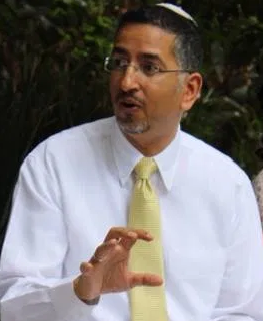
Rabbi Adrian Schell serves as rabbi of Wimbledon Synagogue in South West London. Rooted in Progressive Jewish thought, he aims to build a contemporary Judaism that values diversity, encourages honest theological questioning, and ensures every individual is recognised as an essential part of the communal sacred space.