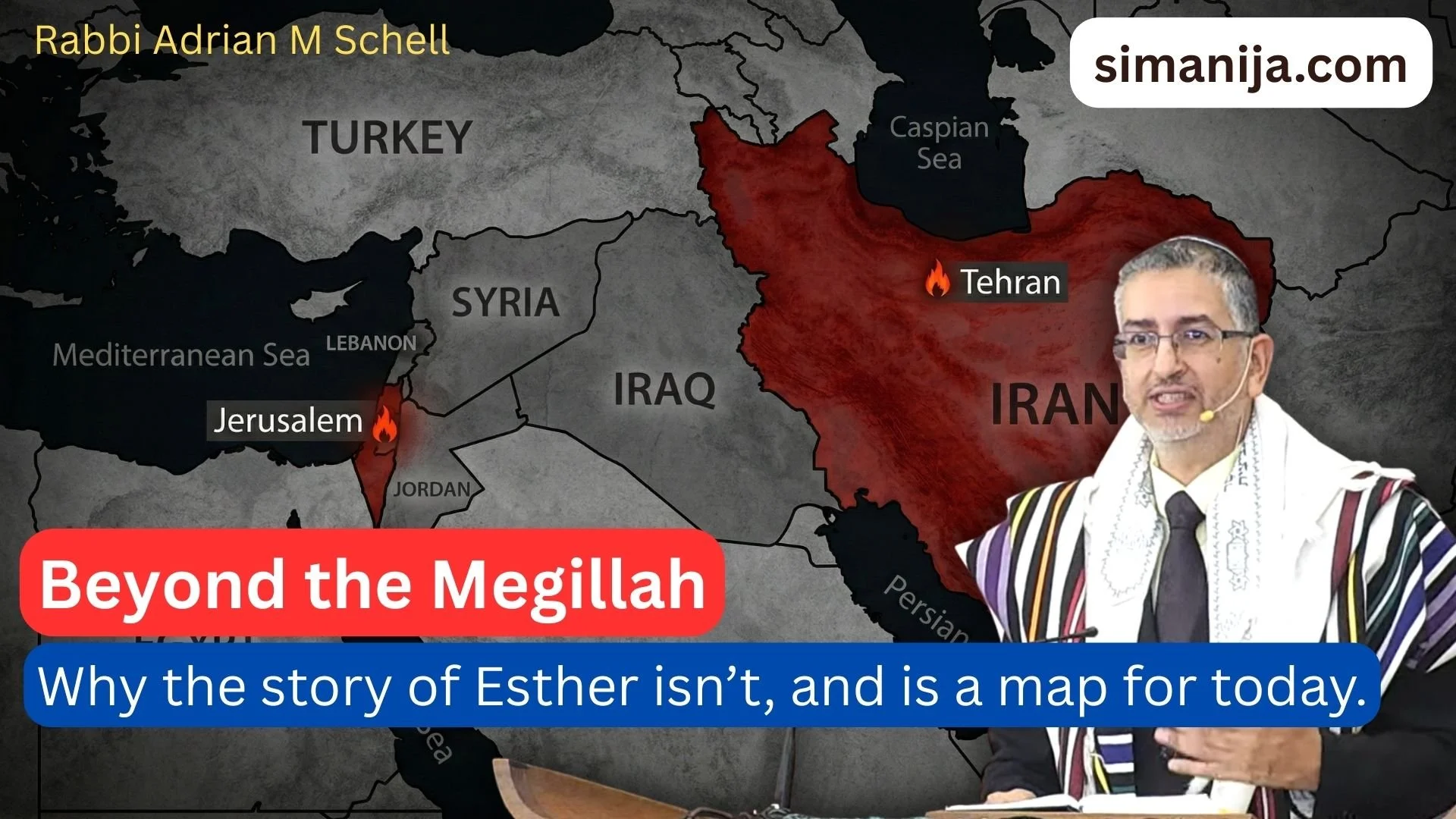
Beyond the Megillah
Why the story of Esther isn’t, and is a map for today.
It is very unusual for me to give a sermon on Purim, but the news from the Middle East once again completely overshadowed our festival preparations. Between the military escalation and reports concerning the death of the modern-day Haman, feeling the weight of global uncertainty is entirely natural. I view the sudden fall of the dictator and the potential end of a regime, which has long threatened Israel and destabilised the region, with cautious, and some complex feeling of relief.
Yet, that relief is immediately tempered by deep anxiety. Questions about what happens next, whether the situation will escalate further, and how this threatens our own security here in the UK are taking away most of the joy I usually feel this time of the year. I know people are frightened, and I share that concern with you.
In times of such upheaval, the temptation to look for direct parallels in our sacred texts is remarkably strong. We might want to treat the Book of Esther as a predictive map for the evening news, neatly casting today's figures into the roles of Haman or Ahasuerus.
I am wary of such easy comparisons. The world of the Megillah is not the world of 2026. Treating it as a simple mirror risks flattening the complexity of the human lives caught in the crossfire today. As I wrote last week, history too often reminds us that we rarely learn from history.
Instead of seeking a blueprint for geopolitics, I want us to focus on the timeless ideals the Esther story protects: hope and courage.
At the beginning of last month, our community had the privilege of welcoming Shanta from the local Baha’i community. She spoke to us with such grace about the situation in Iran and the immense courage shown by those who still live in the birth country of their faith despite systematic persecution. When the news of the military action broke over the weekend, my first thought was for our Baha’i friends. I reached out to them to send our greetings of solidarity and our prayers that their families and friends would remain unharmed.
Their response was simple and humbling: gratitude and hope. Even amidst fear, they spoke not of revenge or despair but of prayer and endurance. Their resilience is a modern testament to the quiet strength we see in the Purim story:
the ability to maintain one's identity and faith even when the surrounding environment feels hostile.
At the same time, my thoughts and prayers are actively with our own families and friends in Israel. I had a short conversation with Hannah, who made Aliyah 1 ½ years ago. After a few short months of relative quiet without the sound of air raid alarms, she and other Israelis have once again retreated into safe rooms, waiting for the storm to pass. The sudden shift from a sense of normalcy back into the grip of fear is a toll no one should have to carry.
For her and all our family in Israel, Purim’s joy comes with a heavy measure of anxiety, the laughter mingling with worry.
But even in their fear, there is something profoundly Purim-like: the courage to live, to celebrate life, and to affirm faith in the face of absolute uncertainty.
When we read the Megillah now, we do more than recount a tale from long ago. We enter into a conversation with our ancestors about what it means to be human, vulnerable, and yet capable of courage. The Al ha-nissim prayer of the Amida, reminds us of a time when a wicked leader sought to destroy us, and how those designs were ultimately overthrown. Yet, the true miracle we celebrate is not just the fall of an enemy. It is the endurance of a people.
Esther’s courage was not found in a lack of fear, but in her willingness to address injustice despite it.
She reminds us that our voices matter, especially when they are raised in support of those who are vulnerable, which are for me the people in Iran, who have suffered far too long. Purim teaches that courage is rarely grand or dramatic. Most often, it is the quiet decision to act with integrity when fear would silence us. It is reaching out to comfort another, even when we feel powerless ourselves. It is holding fast to hope, that fragile, unreasonable hope that despite all evidence, humanity is capable of change.
We recite in the blessings after the Megillah that God is our hope in every generation. My hope for this Purim is that the story we tell serves as a bridge to a better future. I pray for a time when future generations will come together to celebrate this festival with only a distant remembrance of persecution.
I hope they will look back at our history as a time when we had to defend ourselves, only so that they could live in a world defined by lasting peace.
Until then, let us hold onto one another, stay engaged in our community, and continue to hope for quieter days ahead.
Purim Sameach.
Endnotes
1. Seder haTefilot, Calendar of the Year, p. 384. Contains the text of the Al ha-nissim prayer detailing the plot of Haman and the deliverance of the Jewish people.
2. Seder haTefilot, Calendar of the Year, p. 385. Contains the concluding blessing for the Megillah reading, affirming God as the source of salvation and hope.
3. Tagesschau.de and other news outlets.